1. Introduction
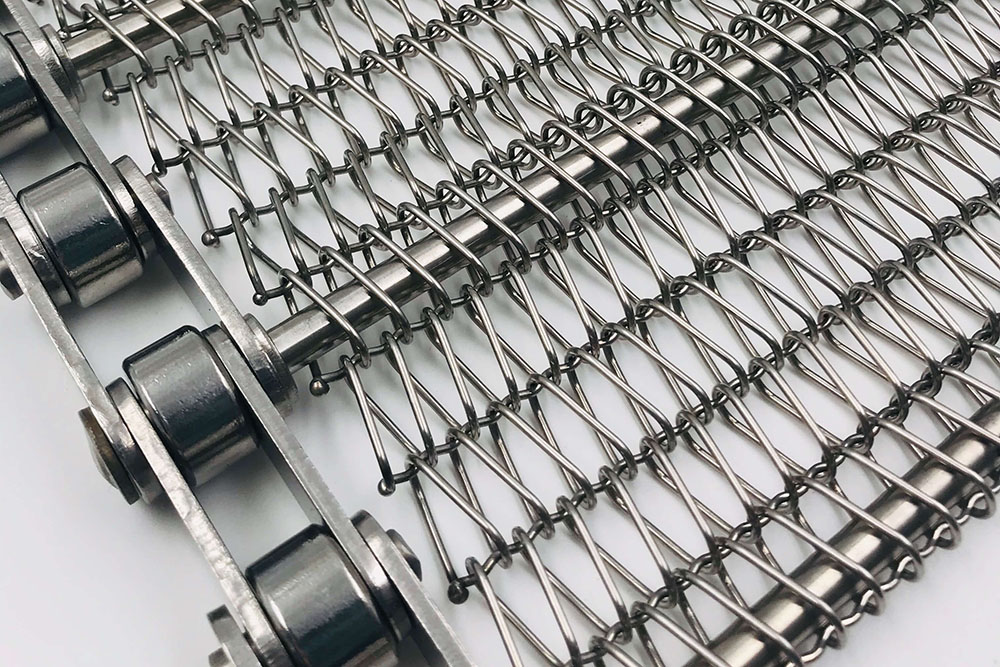
With the continuous advancement of industrial automation and intelligent manufacturing, conveyor belts have become a critical component of modern material handling systems. Their performance and durability directly impact production efficiency and overall operating costs.
Among the wide range of conveyor belt structures available today, spiral mesh (Spiral Mesh) has gradually emerged as a star component in industrial conveying systems due to its unique interlocking woven structure and outstanding physical and chemical properties.
Whether in demanding food processing environments, harsh heat treatment workshops, or complex textile, paper-making, environmental protection, and chemical industries, spiral mesh conveyor belts have demonstrated exceptional value.
This article provides a comprehensive analysis of spiral mesh conveyor belts, exploring their structural characteristics, major application areas, key technical advantages, and practical recommendations for selection and maintenance.
2. Definition and Unique Structural Characteristics of Spiral Mesh
2.1 Interlocking Weaving Mechanism
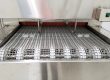
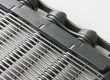
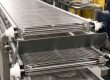
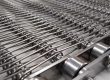
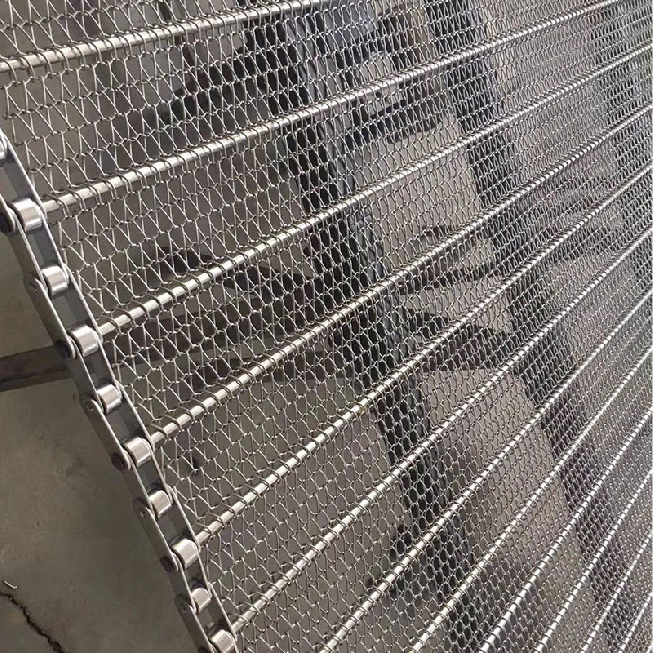
Spiral mesh, also known as a spiral mesh belt, is a continuous mesh conveyor structure formed by alternating right-hand and left-hand spiral coils interconnected by transverse cross rods.
This unique geometric topology distributes tensile forces evenly across each mesh node during operation, effectively reducing stress concentration and enhancing structural stability.
2.2 Core Structural Features
High Tensile Strength with Lateral Flexibility
The continuous spiral-wound structure provides excellent longitudinal tensile strength, enabling the belt to handle heavy conveying loads.
At the same time, it maintains excellent lateral flexibility, allowing it to adapt easily to conveying systems with varying curvatures and turning radii.
Precisely Adjustable Open Area
By adjusting:
- Spiral pitch
- Mesh spacing
- Wire diameter
the open area of spiral mesh can be customized between 15% and 50%, achieving an ideal balance between material support and airflow or liquid permeability.
Smooth and Low-Noise Operation
Special grinding or flattening treatments create a smooth mesh surface without significant protrusions.
When operating with drive sprockets, idlers, and support rails, the belt runs smoothly with minimal vibration and significantly reduced noise levels.
Exceptional Temperature and Corrosion Resistance
Depending on application requirements, spiral mesh belts can be manufactured from:
- Stainless Steel 304
- Stainless Steel 316L
- Stainless Steel 314
- Stainless Steel 310S
- Modified Polyester (PET)
- Polypropylene (PP)
Metal spiral mesh belts can operate continuously within a temperature range from -50°C to 1100°C, while offering excellent resistance to acids, alkalis, and chemical solvents.
3. Four Core Application Areas of Spiral Mesh Conveyor Belts
3.1 Food Processing Industry: Combining Hygiene and Efficiency
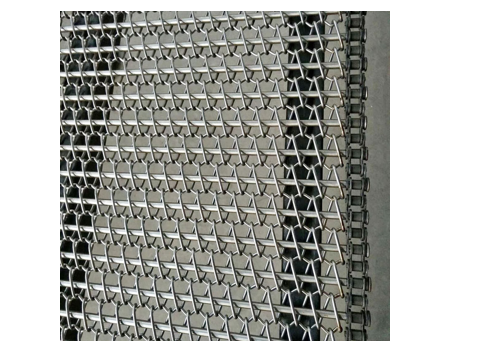
In highly automated food production lines involving baking, freezing, frying, cooling, and drying, food-grade stainless steel spiral mesh belts play a critical role.
Tunnel Ovens
With an open area exceeding 35%, hot air can circulate uniformly through products, ensuring consistent baking results for bread, pastries, and other baked goods.
IQF Spiral Freezers
High airflow permeability enables rapid cold air circulation, shortening freezing times while preserving freshness and preventing products from sticking together.
Continuous Frying Systems
Manufactured from high-temperature-resistant stainless steel, spiral mesh belts withstand hot cooking oils while minimizing residue buildup, making cleaning easy and ensuring compliance with strict food safety standards.
3.2 Heat Treatment and Industrial Drying: Stable Performance Under Extreme Conditions
Industries such as:
- Ceramic sintering
- Refractory curing
- Electronic component packaging
- Chemical fiber drying
require conveyor belts capable of enduring continuous high-temperature operation.
Spiral mesh maintains excellent dimensional stability under repeated heating and cooling cycles, reducing thermal expansion, deformation, and tracking issues.
Its modular connection systems and welded loop joints also allow rapid installation, repair, and partial replacement, significantly reducing downtime and maintenance costs.
3.3 Textile and Dyeing Industry: Gentle and Mark-Free Conveying
Textiles transported through:
- Stenter frames
- Printing and drying lines
- Washing systems
require conveyor belts with smooth surfaces and precise tension control.
The smooth spiral mesh surface prevents:
- Fabric snagging
- Surface marking
- Material damage
while its resistance to heat, humidity, dyes, and chemical solvents ensures long-term performance in harsh processing environments.
3.4 Environmental Protection and Waste Treatment: Conveying and Filtration in One
In environmental engineering applications such as:
- Sludge dewatering
- Waste sorting
- Plastic recycling and washing
spiral mesh often serves dual functions as both a conveyor belt and a filtration medium.
In screw press dewatering systems, high-strength PET spiral mesh belts withstand significant compression forces while allowing efficient water drainage through their uniform openings, improving solid-liquid separation efficiency and increasing sludge cake solids content.
4. Comparison Between Spiral Mesh and Traditional Conveyor Belts
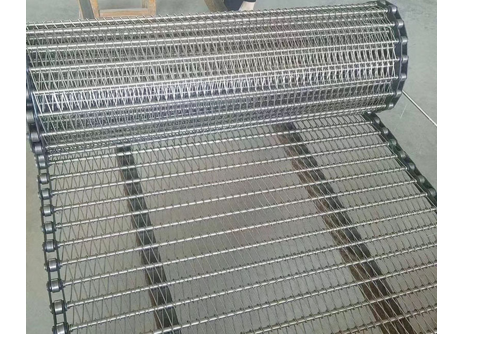
To help engineers and purchasing professionals better understand the advantages of spiral mesh belts, the following comparison highlights key differences between spiral mesh, PU/PVC flat belts, and conventional metal woven belts.
| Comparison Factor | Spiral Mesh Belt | PU/PVC Flat Belt | Conventional Metal Woven Belt |
|---|---|---|---|
| Air and Water Permeability | Excellent (15%-50% adjustable) | Nearly zero | Good, but openings can deform |
| Self-Cleaning and Washability | Excellent, no dirt-trapping areas | Prone to adhesion and surface wear | Difficult to clean, dirt accumulates at intersections |
| Temperature Resistance | -50°C to 1100°C (material dependent) | Below 120°C | 300°C to 1100°C |
| Lateral Flexibility and Turning Capability | Excellent, suitable for tight-radius curves | Poor, mainly straight-line conveying | Moderate, deformation may occur during turning |
| Maintenance and Installation | Modular design, easy replacement | Requires heat welding or adhesive joining | Requires special tools or welding |
| Service Life and Cost Performance | Long service life, excellent ROI | Faster aging and replacement cycles | Moderate lifespan, edge fraying possible |
5. Conclusion and Future Outlook
In summary, spiral mesh conveyor belts have successfully addressed multiple industrial challenges including:
- Efficient material conveying
- High airflow and liquid permeability
- Wide temperature resistance
- Strict cleanliness requirements
Their unique geometric and mechanical structure provides advantages that are increasingly difficult to replace in modern industrial applications.
As modular conveyor system design continues to evolve and material science advances, future spiral mesh conveyor belts will no longer serve solely as passive conveying components.
By integrating miniature sensors into spiral coils and cross rods, modern spiral mesh systems are gradually evolving into intelligent conveying solutions capable of:
- Real-time tension monitoring
- Dynamic material tracking
- Automatic belt alignment correction
Through proper initial selection and well-planned maintenance strategies, companies can significantly improve production efficiency, reduce energy consumption, and achieve long-term economic benefits.
Request a quote